
SYS.BLOG
How I Vibe Coded a Site to 1 Million+ Visitors
A vibe coding case study: Rifle Configurator got 1.2 million visitors in 11 months with Codex, Claude Code, and always-on agents. I never read the code.
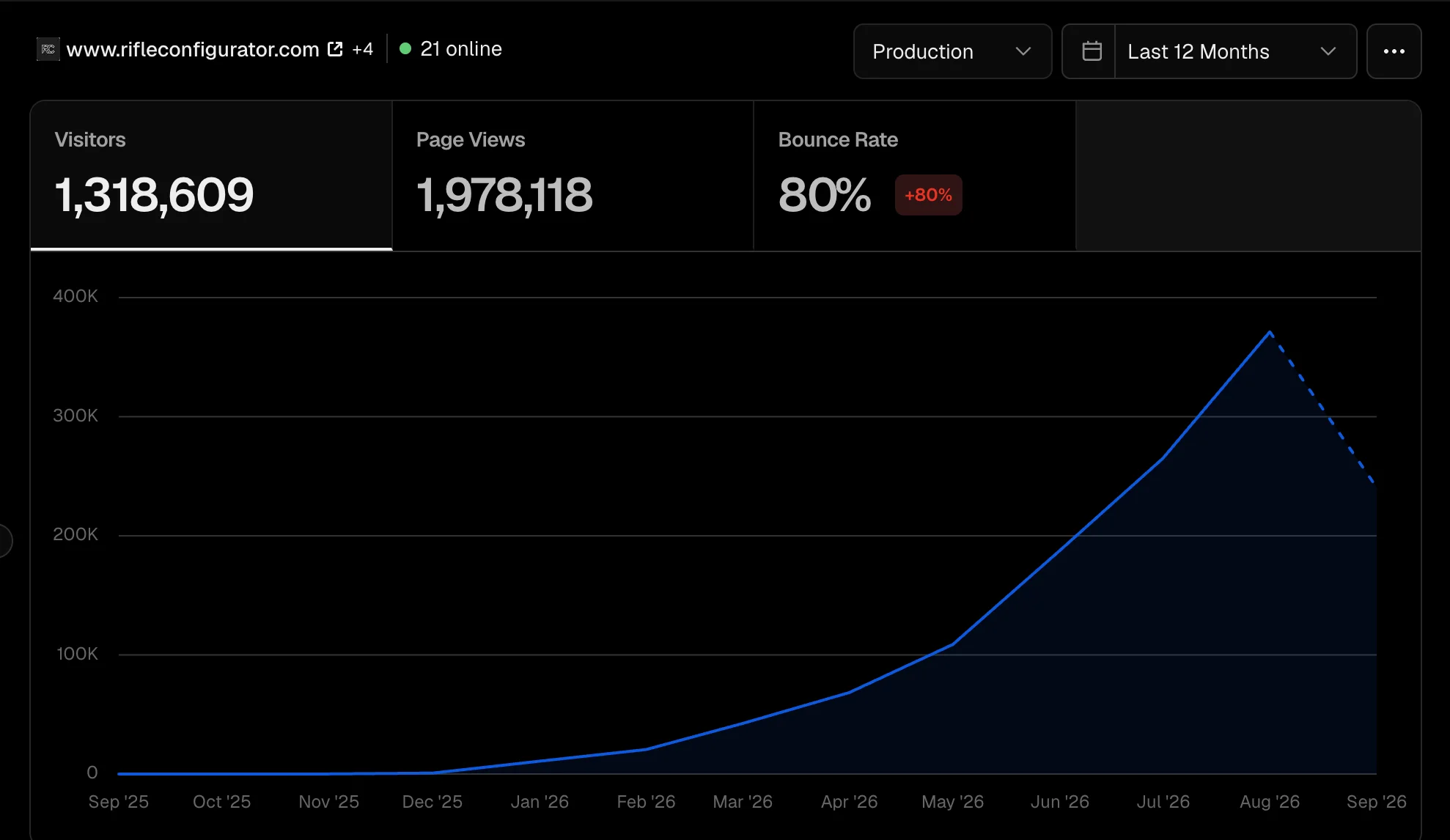
Eleven months ago Rifle Configurator did not exist. Since then it has had 1.3 million visitors, it just hit 400,000 a month, and I have not read a single line of its code. It's also profitable.
Vibe coding means you describe what you want and AI agents write all of the code. Most examples you'll find are toy apps and weekend demos. This one is a production site with hundreds of thousands of lines of code, real traffic, and real revenue. Here's how it happened, and what I'd tell a founder trying to do the same.
Start with a problem you actually have
I built it to solve a problem I had: planning out rifle builds. The first commit went in on October 8, 2025, and the first version came out of Codex running GPT-5. The Rifle Configurator project page covers how the compatibility engine works.
Pretty quickly it became a two-agent project. Codex did the backend and the builder logic. Claude Code did the content and the guides. If you want the full breakdown, I've compared Claude Code, Codex, and Cursor in detail.
Effort does not get clicks
The guides shipped on October 21, 2025, two weeks after the first commit. I had years and years of research in my head and I wanted to put it out there, so I wrote guides on things like rifle barrel length and night vision.
I put a lot of effort into those guides. No one clicked them. That's when I found out about SEO.
The secret to SEO: tell Claude “make the SEO better”
Turns out the secret to search engine optimization is to just tell Claude “make the SEO better,” repeatedly. Maybe I should sell a course.
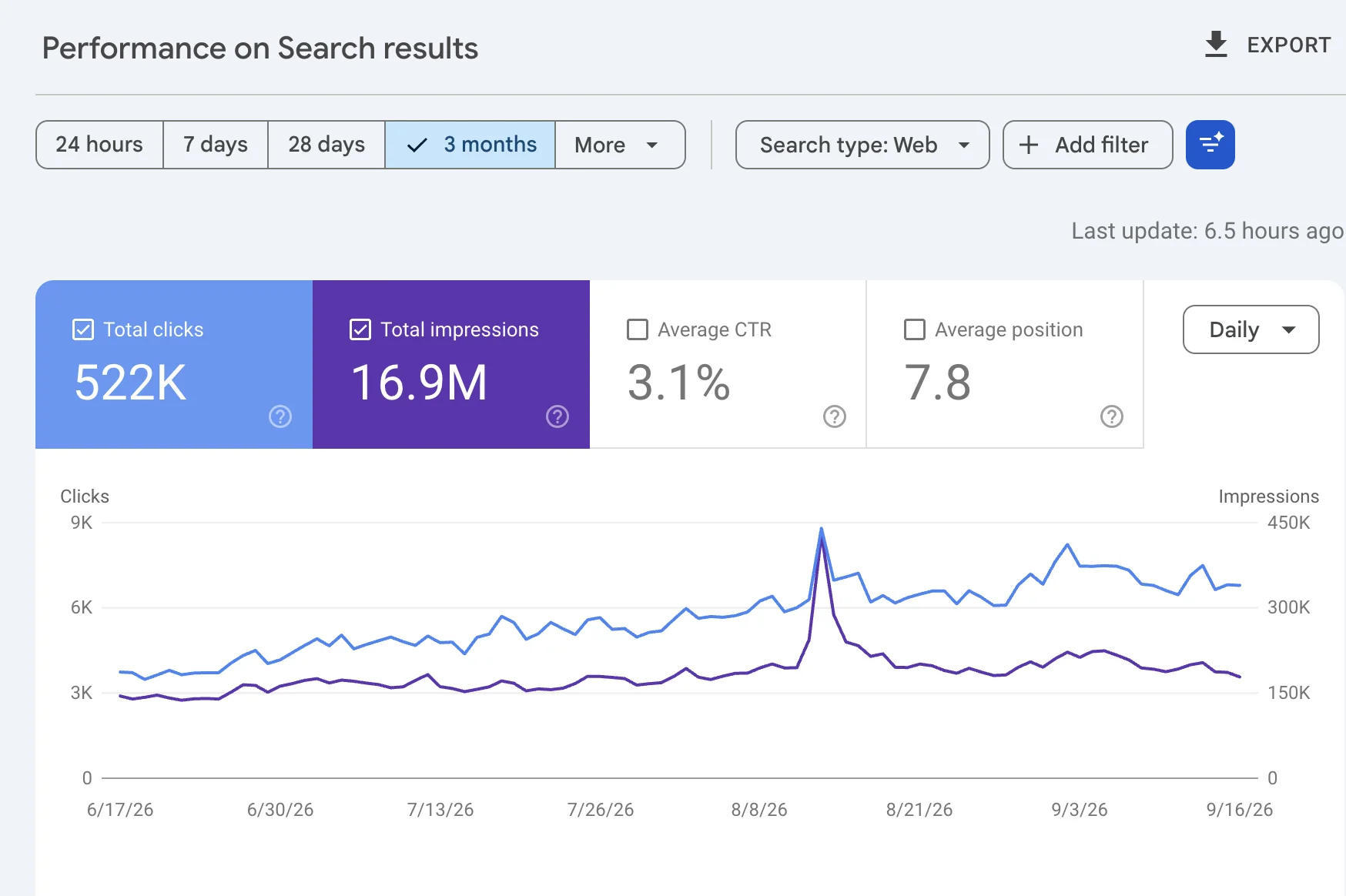
That's 522,000 clicks and 16.9 million impressions in three months, at an average position of 7.8. So I'm only partly joking. That really is most of what I typed. The rest is trade secrets, and I'm keeping those.
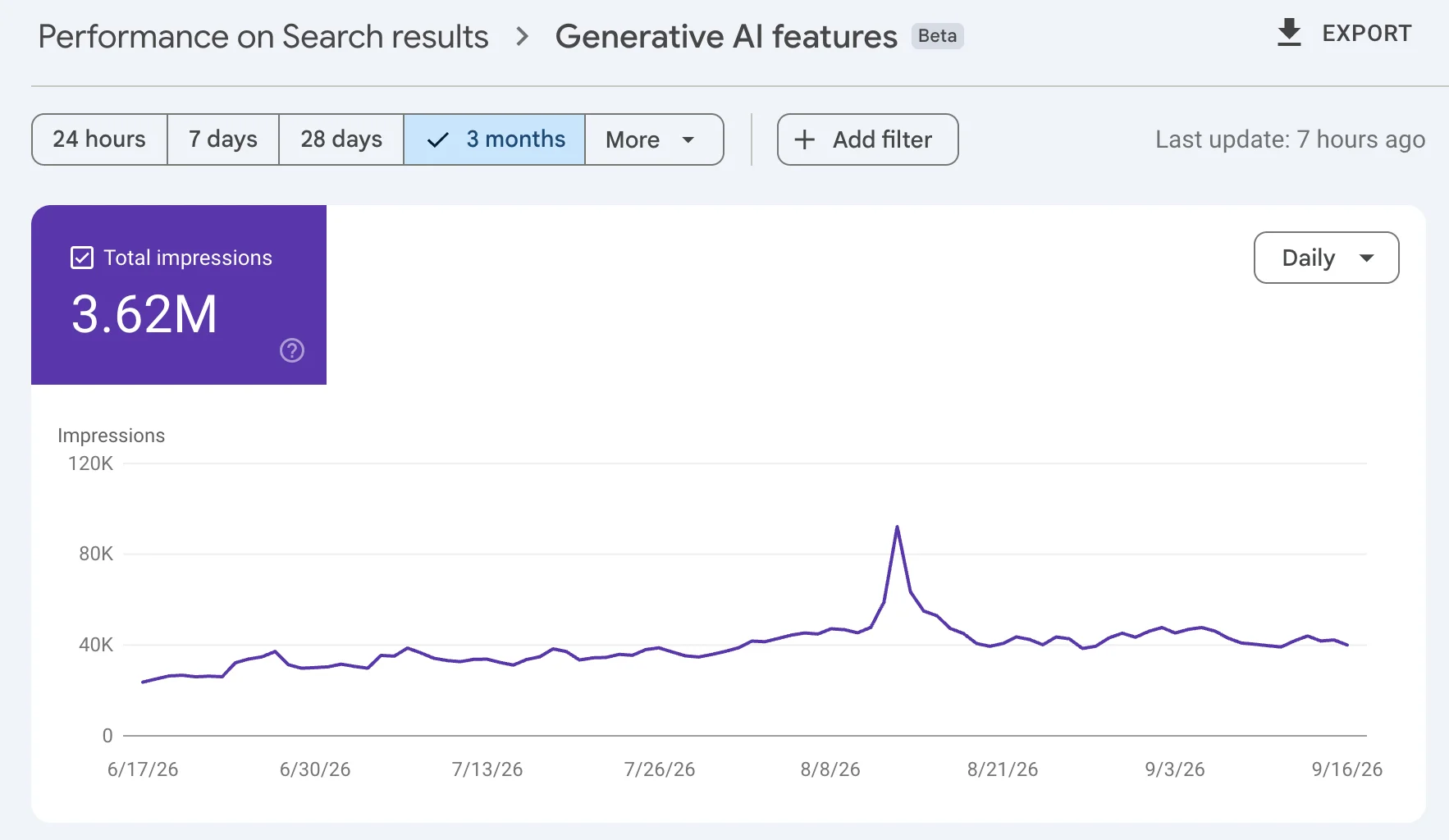
Claude did the GEO too. GEO is generative engine optimization, which means getting your pages cited in AI answers the way SEO gets them ranked in search results. Google's generative AI features showed Rifle Configurator 3.62 million times in those same three months.
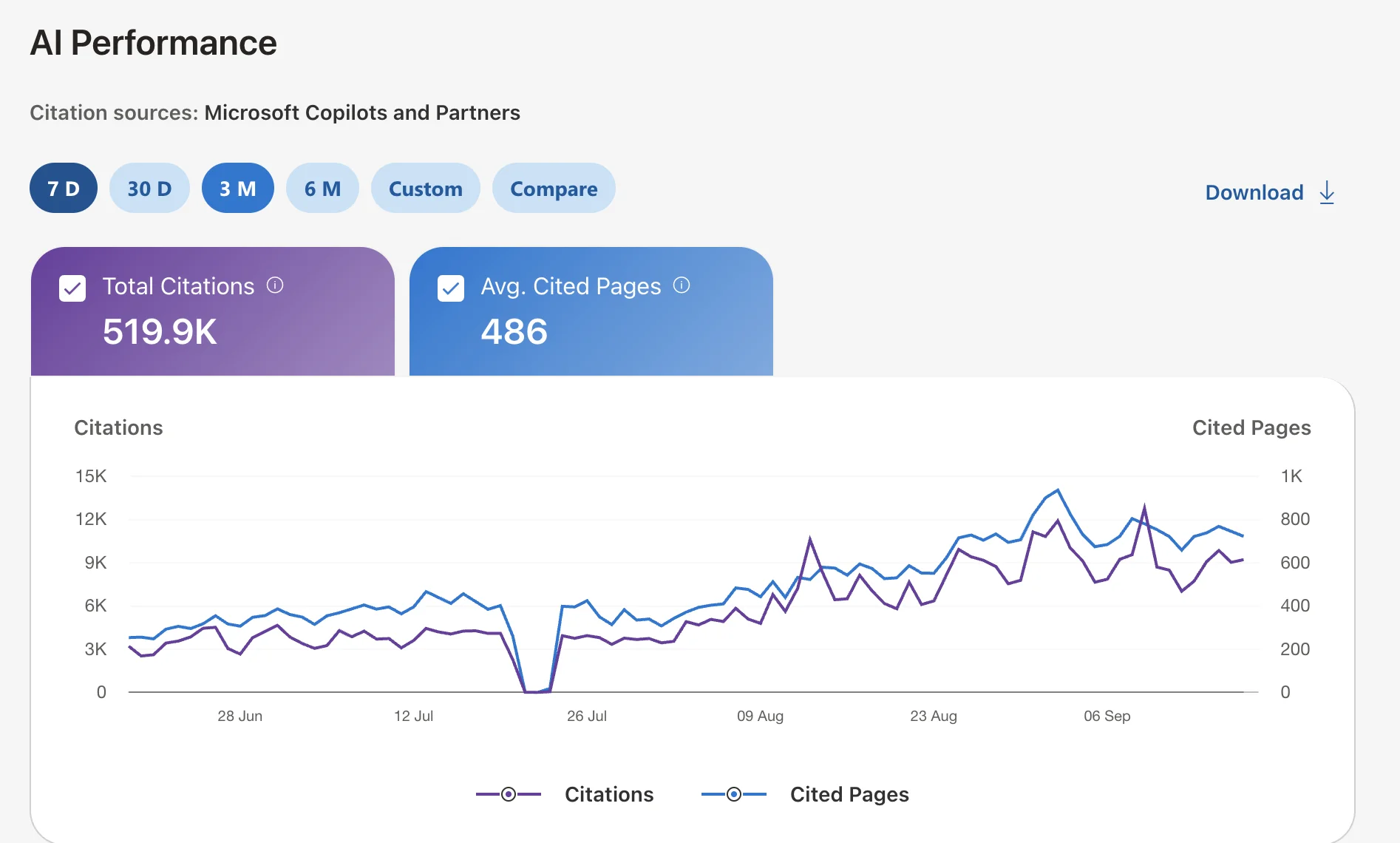
Bing counts the citations directly. Microsoft Copilot and its partners cited the site 519,900 times in the last three months. That was about 1,000 citations a day back in March, and it's about 9,000 a day now, across an average of 486 different pages.
Anytime you ask an AI anything about firearms, there's an extremely good chance it quotes me. We're in the training data, and we're in the search results.
What I will share is the free version. My AI SEO optimizer scores a page for both search and AI citation, and the SEO patterns that worked on Rifle Configurator are the ones I applied to this site.
Be first on the news, and cover everything
The articles system shipped on January 17, 2026, and that's when things really took off. The whole idea was to cover the latest news before anyone else could.
Today that runs on always-on AI agents. They find out about the news before anyone else does, and then AI writers cover everything. Every article still goes through the same fact-checking as the guides.
Monthly visitors went from 42,443 in March 2026 to 369,169 in August. The site now has 471 guides and 357 articles.
The press noticed too. USA News profiled Rifle Configurator on September 15, 2026, and Soldier Systems Daily ran our 1.2 million visitor announcement two days later.
People don't want to learn, they want to buy
At that point it was just traffic, no revenue. Then I realized people don't actually want to learn. They just want to buy stuff. So I wrote the answer to the question they were really asking: what are the best things to buy?
Strangely, this applied to traffic too. The buying guides got more traffic than the educational guides, not just more revenue. I don't know why for sure. My guess is YMYL, “Your Money or Your Life,” which is Google's term for topics where bad advice can hurt someone, and which it holds to a higher standard. Educational firearms content may fall under it in a way that a list of products doesn't.
The other suspect is AI Overviews, the AI answers Google puts above the search results. An AI Overview can answer an educational question right on the results page, and then nobody needs to click. We've been fighting AI Overviews this whole project, and honestly it's still an open question.
Buying guides are what turned visitors into affiliate revenue. One lesson from restructuring them in March: put the products first. It grew from there, and on July 9, 2026 we started running display ads too.
Put always-on agents on the work you'd never get to
The outreach agents have brought in over $7,000 of review material. Agents write the outreach emails, and agents keep track of what arrives.
The first of them was Hermes. It's the open source Hermes Agent from Nous Research, it's always running, and it has its own server. I wrote about it in my Hermes Agent post. Hermes is tied into our price sync process and runs the overnight jobs on its own machine. It's basically my personal assistant: it tracks the review items I've received, tracks expenses, and can open PRs while I'm on the go.
Recently Grok Bot has taken over a lot of those jobs. Grok Bot is xAI's AI teammate product: each bot has its own computer, signs in to your tools, and works 24/7. I now use it exclusively for outreach.
The agents also handle the random mail I get from lost people. They help me help people I otherwise would not have had time to respond to.
Build tools for your agents, not just your users
A lot of supporting tooling came out of this project. When an article's source is a YouTube video, the agent calls my YouTube analysis MCP server to summarize it. Article images come from my image generation MCP server. MCP (Model Context Protocol) is the standard way to give an AI assistant new tools. The entirety of Dream Pixel Forge started as supporting tooling too, because the site needs high-resolution product shots of things that are sometimes not in any image model's training data.
Inside the repository there are 223 package scripts, 19 agent skills, and 19 GitHub Actions workflows, all built for agents to run. I covered the general approach in structuring a project for AI agents.
Things will break. Turn every break into a check
So many agents, so many worktrees, more than 6,000 commits, hundreds of thousands of lines of code, and I didn't read a single line. Did things break? Yes. We've had many failures.
One time all affiliate clicks stopped loading. Another time the link on our most popular item broke. Another time we dropped tracking for Safari users, who happen to be the most numerous users of the site. In fact we have a lot of issues with Safari users, and I wish they would buy a real phone. We had another affiliate link break today, so it's ongoing.
We also got removed from the Bing index twice for no apparent reason. You can see one of them in the Bing chart above, where the citations randomly drop to zero for a few days in late July. I put that one down to Microsoft's engineers.
Every time something breaks, we write regression tests and add a new round of checks.
None of this ever took the site down. On Vercel's deploys we've never had a full outage, knock on wood. The failures that hurt are the quiet ones, where the site works fine and the revenue is zero.
Skip the code, keep the mental map
Not reading the code is not the same as not understanding the system. I'm a software engineer, and I keep a high-level mental map of how everything fits together. It helps me prompt a lot better than a truly blind vibe coder would. The workflow itself is in how to vibe code large projects.
To scale quality content with AI, automate the fact-checking
You scale quality content with AI by having a subject matter expert prompt the AI and watch over it, and by building fact-checking workflows. Those are two different jobs.
One of the biggest screwups we had was a shotgun stock that was entirely hallucinated. It literally does not exist, and the agents cataloged it anyway. The fact-checker came after that.
The fact-checking is adversarial. Claude researches and writes a guide, deterministic checks run, and then Codex goes over every changed guide or article hunting for wrong claims. Each finding gets verified against a primary source before it's accepted, and nothing gets replaced with a made-up fix. One guide took about six rounds to go green. You can judge the result yourself in the Rifle Configurator guides.
It catches many, many things, including some pretty serious errors. The same kinds of mistake come back over and over: superlatives about how common something is, materials nobody verified, prices that are too precise, parts that “fit everything,” and gun myths that were debunked years ago.
The subject matter expertise, honestly, comes in at a higher level. It's strategy and direction: what do we focus on, what's popular right now, having a read on the community. No workflow gives you that. There's also one fine-detail job that is still mine: catching the images that look slightly off.
So if you're a founder chasing this, don't spend your expertise proofreading. Build the machine that checks the facts, and spend your own time on where to point it.
I take a small number of clients on retainer as a fractional CTO and agentic engineering consultant. That means building systems like this one: the agents, the checks, the content pipeline, and yes, the SEO. If you're going to ask me for the trade secrets for free, the answer is “tell Claude to make the SEO better.” If you have a budget, the answer is longer.
FREQUENTLY ASKED QUESTIONS
What is vibe coding actually?
Vibe coding means you describe what you want in plain language and AI coding agents write all of the code. Rifle Configurator was built this way with Codex and Claude Code, and its owner has not read a single line of the code.
Can AI really build me a website?
Yes. Rifle Configurator was built entirely by AI coding agents, starting with Codex on GPT-5 in October 2025, and it reached 1.2 million visitors in 11 months. It has had occasional outages, mainly in affiliate tracking, but never a full code red.
How do you scale quality content with AI?
Scaling quality content with AI takes fact-checking workflows plus a subject matter expert who sets the direction. On Rifle Configurator, Claude writes each guide and Codex runs an adversarial fact-check that catches the factual errors. The expert decides what to cover, reads the community, and catches images that look slightly off.
How much traffic does Rifle Configurator get?
Rifle Configurator passed 1.2 million visitors in its first 11 months, with 391,084 visitors in the 30 days before September 12, 2026. Monthly visitors grew from 42,443 in March 2026 to 369,169 in August 2026, mostly from Google organic search.